FEDERICA BERTONIAI Risk · Cyber Intelligence · Digital Evidence Review

From threat to decision

Strategic Cyber Threat Intelligence, cyber geopolitics, and AI Risk for boards and organizations making decisions in complex, dynamic, and highly uncertain environments.

Conferences · Teaching · Science Communication

Sharing knowledge. Building awareness. Anticipating change.

For nearly twenty years, Federica Bertoni has contributed to university teaching as an external expert, delivering specialist lectures and seminars on the evolution of digital technologies, digital evidence, cyber intelligence, and artificial intelligence.

Throughout her professional and research career, F.B. has had the privilege of speaking and teaching at universities, university postgraduate programs, advanced training institutions, professional bodies, academic conferences, institutional forums, and specialist events devoted to digital forensics, cybersecurity, and digital transformation.

F.B.’s contributions sit at the intersection of technology, law, digital investigations, governance, and security, with an approach that combines technical rigor, forensic methodology, strategic analysis, and legal reflection.

While digital forensics is the foundation of her career, F.B.’s work now extends to a broader field encompassing cyber intelligence, a return to cyber threat intelligence, critical review of digital evidence, artificial intelligence, AI-enabled cyber threats, Web3, blockchain, digital ecosystems, institutional resilience, and the protection of trust in decision-making systems.

Conferences and teaching provide more than opportunities to share knowledge. They are valuable occasions for reflection and exchange among research, professional practice, and technological innovation, helping disseminate rigorous methods for addressing increasingly complex digital phenomena.

The goal is to provide interpretive tools and analytical models that help judges, prosecutors, attorneys, technical experts, investigators, professionals, businesses, and public decision-makers understand the new challenges posed by technological change.


Research and method. From sources to the critical assessment of digital evidence.
Dialogue and learning. Connecting expertise, questions, and perspectives.
TOPIC AREAS

Federica Bertoni’s principal areas of research, analysis, and inquiry

Her research, consulting, academic writing, and science communication lie at the intersection of emerging technologies, digital risk, cyber intelligence, and decision-making processes. Although they address distinct topics, they share a common objective: to understand how technological change is redefining security, governance, the value of digital evidence, and organizational resilience.
Research sources and tools for intelligence and digital threat analysis.

Cyber Intelligence and Cyber Threat Intelligence

Analysis of digital threats, intelligence-driven investigations, state and non-state actors, campaigns, and emerging threats. Critical assessment of sources and signals that help explain capabilities, intentions, and potential developments.
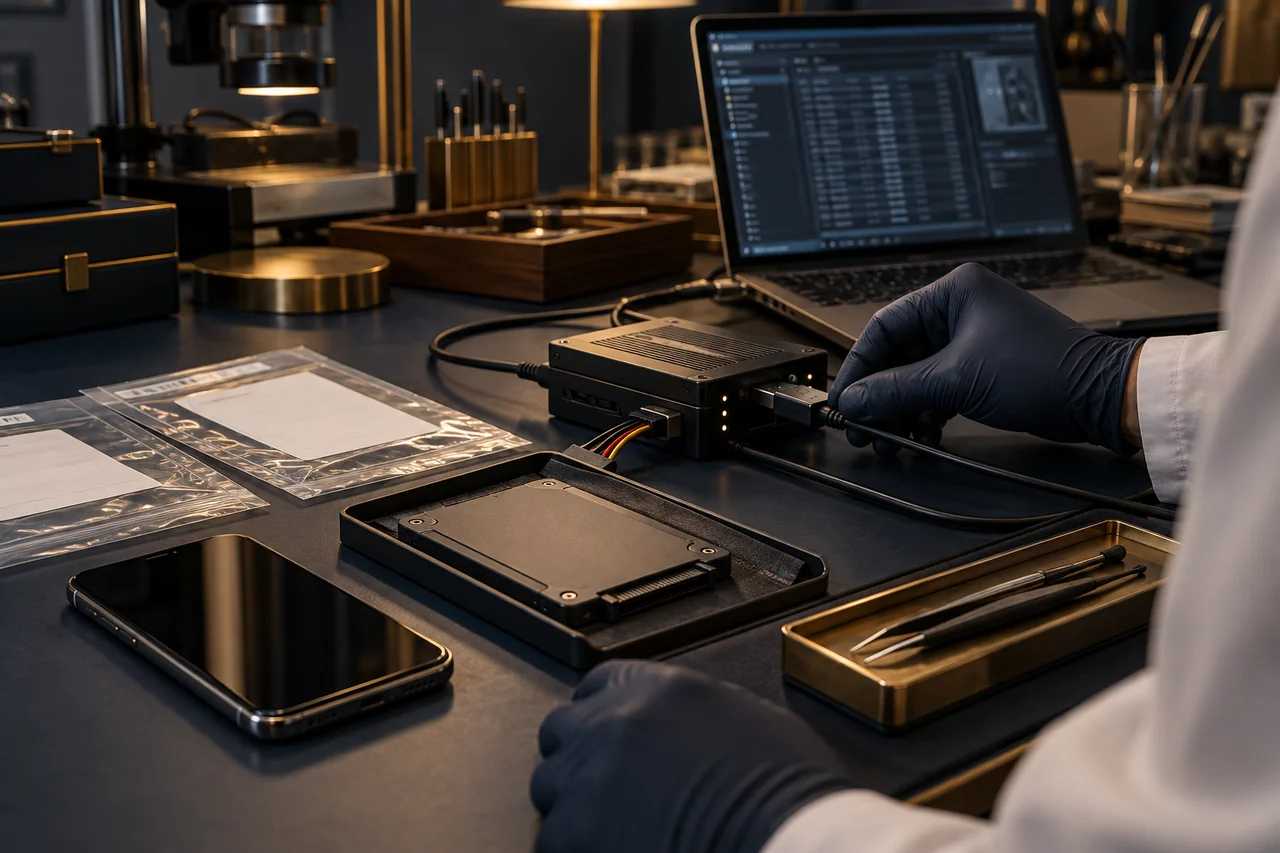
Devices and digital storage media examined at a digital forensics workstation.

Digital Evidence
& Digital Forensics


Digital evidence, forensic methodology, critical review of evidence, digital investigations, and international best practices.
A visual composition exploring artificial intelligence systems and human oversight.

A.I. & A.I.-enabled Cyber Threats


Artificial intelligence, deepfakes, AI fraud, information manipulation, autonomous systems, and new investigative paradigms.
Interconnected elements evoke distributed ledgers, blockchain, and digital trust.

Web3, Blockchain & Digital Assets

Decentralized technologies, blockchain ecosystems, new models of digital risk, and the transformation of digital infrastructure.
Contemporary architecture and spaces for discussion evoke trust in institutions.

Digital Governance & Democratic Trust

The impact of emerging technologies on decision-making processes, institutions, democratic resilience, and the protection of fundamental rights.
A representation of global connections among routes, infrastructure, and digital networks.

Cyber geopolitics and strategic dependencies

Connections among geopolitical competition, cyber threats, and technological dependencies. Analysis of supply chains, critical infrastructure, and crisis scenarios to understand their implications for organizations and decision-making processes.

From digital evidence to the governance of technological risk

The following list documents the evolution of F.B.’s academic and professional interests, from her early work in legal informatics and digital forensics to her most recent contributions on artificial intelligence, cyber intelligence, digital risk, and the governance of emerging technologies. 

THE COMMON THREAD

Although they address different topics, all of these contributions share a common thread: understanding how technological innovations transform the acquisition, assessment, and interpretation of digital evidence, while also influencing law, security, institutions, and public trust.

An analytical workflow organized around sources, hypotheses, and synthesis documents.
2025 – 2024 | Digital Forensics, AI & Legal Frontiers
A specialized educational session in an academic setting.
  • 2026 – Forensics After Intent: Responsibility, Evidence and Investigative Truth in the Age of Synthetic Reality, and Advanced Case Studies and Further Application Scenarios, two-module lecture, University of Milan — Postgraduate Program in Cybercrime and Digital Investigations, March 5, 2026.
  • 2025 – Digital Forensics in Italy: Between Procedural Formalism and Failures in Digital Evidence Management, Legal Informatics Course, University of Brescia, May 7, 2025 (online).
  • 2024 – Femicide, Digital Violence and Cybersecurity: Analysis and Countermeasures, Legal Hackers Lugano, November 25, 2024.
  • 2024 – The Human Factor in Insider Threats: Case Studies, Forensic Strategies and AI Applications, University of Milan — Postgraduate Program in Cybercrime and Digital Investigations, November 14, 2024.
  • 2024 – Artificial Intelligence and Disinformation: The Challenges for Law and Digital Forensics in Decoding Contemporary Truths, Legal Informatics Course, University of Brescia, April 17, 2024.
  • 2024 – Law and the Digital Realm: A Clash of Titans via Digital Forensics. Case Studies, Challenges and Prospects (adapted for legal practitioners), Conference on Digital Evidence and the Courtroom, Bar Association of Vicenza, January 26, 2024.
2023 – 2022 | Cybercrime, Disinformation & Sector-Specific Risks
A discussion among speakers and professionals at a conference.
  • The Danger of Revenge Porn: Protective Measures and Legal Tools (Part 5), Internet Festival Pisa – Forms of the Future, November 24, 2023.
  • AI and Fake News, University of Milan — Postgraduate Program in Cybercrime and Digital Investigations, November 22, 2023.
  • Cybersecurity Risks in the Connected Vehicle Ecosystem: A Digital Transformation Perspective on Network Security – asynchronous delivery in English, University of Brescia, Faculty of Engineering, November 2023.
  • Cybersecurity Risks in the Connected Vehicle Ecosystem – delivered in Italian with English slides, University of Brescia, May 30, 2023.
  • Law and the Digital Realm: A Clash of Titans via Digital Forensics, Legal Informatics Course, University of Brescia, April 20, 2023.
  • Ethics, Cybersecurity and Digital Forensics, University of Brescia — CyberChallenge 2023, March 2, 2023.
  • Phishing and Digital Identity Attacks in the Age of Global Crises – Part II (Case Study), University of Milan, January 7, 2023.
  • Phishing and Digital Identity Attacks in the Age of Global Crises – Part I, University of Milan, November 15, 2022.
2021 – 2020 | Online Violence, Safety & Early AI Applications
  • Revenge Porn and Digital Forensics: Challenges and Best Practices, University of Milan, December 16, 2021.
  • Forms of Online Violence Against Women and Minors: Emerging Safety and Cybersecurity Imperatives, Apulia Cybersecurity Forum, November 9–12, 2021.
  • Introduction to Digital Forensics and Digital Investigations: Best Practices, Legal Evolution and Challenges, University of Brescia — School of Specialization for Legal Professions, June 21, 2021, and April 8, 2021.
  • Espionage, Surveillance and Lawful Interception Tools, University of Milan — Postgraduate Program in Cybercrime and Digital Investigations, October 2020.
  • Cyberbullying, Audiofonetica School, Brescia, April 6, 2020.
2019 – 2018 | Advanced Forensics & State-Level Cyber Threats
  • Electronic Voting, Rousseau Platform, Cybersecurity, the Web and Politics, Bergamo, November 16, 2019.
  • Developments in Mobile Forensics: Best Practices and Defense Objections, Scandicci, November 7, 2019.
  • Introduction to Digital Forensics and Digital Investigations, University of Brescia, May 28, 2019.
  • Lawful Interception Tools: Legal and Forensic Considerations, University of Brescia, May 28, 2019.
  • The San Bernardino Case: Legal, Security and Forensic Implications, University of Brescia, May 28, 2019.
  • Awaiting Godot: State-Sponsored Trojans and the Never-Ending Reform, Security Summit Milan, March 14, 2019.
  • Deepfakes: Manipulate and Rule – The Malicious Use of AI for Disinformation and Propaganda, DTLC Conference 2018, Milan, December 14, 2018.
  • *E-Voting and Democracy (?) *, Bergamo, December 1, 2018.
  • Timeo Danaos et Dona Ferentes: State-Level Malware Between Instrumental Intrusiveness and Normative Persuasiveness, Legal Informatics Conference, Pavia, November 23, 2018.
  • Cyberbullying and the Protection of Minors, University of Milan, November 22, 2018.
  • The Cyber-Physical Safety of Individuals and the Use of AI in Combating Online Hate Speech, Security Summit Rome, June 7, 2018.
  • Hate Speech and Freedom of Expression: AI as a Testing Ground, University of Brescia, May 24, 2018.
2017 – 2016 | Public Engagement & Legislative Debates
Volumes, folders, and editorial materials preserved in a research archive.
  • Game of Phones: Encryption by Design in the Post-Snowden Era, Legal Informatics Conference, Pavia, November 24, 2017.
  • From Incident Response to Corporate Forensics: Best Practices and Operational Models for Digital Evidence Management, Cyber Resilience Forum, Gubbio, June 19–20, 2017.
  • Electronic Voting: Opportunities and Risks on the Road to E-Democracy, Security Summit Rome, June 8, 2017; Security Summit Milan, March 16, 2017.
  • New Frontiers in Vehicle Forensics, IISFA Forum, Milan, May 19, 2017.
  • Gender-Based Violence and Smartphone Forensics, University of Brescia, November 22, 2016.
  • Unlocking the iPhone PIN – FBI vs Apple and the San Bernardino Case, Security Summit Rome, June 7–8, 2016.
2008 – 2005 | Pioneering Work in Legal Informatics
Research materials undergoing comparison and methodological verification.
  • Computer Forensics Between Technological Evolution and Legal Revolution, Brixia Forensics Institute, Brescia, October 22, 2008.
  • The Italian Digital Administration Code: New Provisions, Operational Impacts and Local Government Application, Milan, May 19, 2006.
  • Lecturer in Legal Informatics, postgraduate master’s program promoted by Regione Lombardia and the European Social Fund, 2005.

The complete list of my talks, lectures and conference contributions is available upon request.
The list presents a selection of her principal teaching, training, and science communication activities. A complete record of conferences, seminars, university lectures, and institutional presentations is available upon request.

You stay in control

Your preferences

The site does not include advertising, browsing analytics, or profiling. You can choose whether to remember your accessibility settings for subsequent pages and visits.

Technical functions

Always necessary

Once you make a choice, the browser stores it for 6 months so it can be respected without displaying the notice on every page. This record contains no personal identifiers and is not sent to the site.

Stores text size, contrast, link underlining, and reduced motion settings on your device. Settings are not sent to the Data Controller or to third parties. Without this option, you can adjust them on the current page.

These settings expire when your choice expires: no later than 6 months. If you reject or disable this option, saved settings are deleted; active settings remain available on the current page.

This choice does not authorize future tools or services. For full details, including any technical security tools used by the hosting provider, read the cookie and preferences policy.