Strategic Cyber Threat Intelligence, cyber geopolitics, and AI Risk for boards and organizations making decisions in complex, dynamic, and highly uncertain environments.
Strategic intelligence, cyber geopolitics, and AI Risk
Independent analysis for complex decisions
Federica Bertoni’s practice provides independent intelligence and specialist advisory services at the intersection of Strategic Cyber Threat Intelligence, cyber geopolitics, AI Risk, and Decision Integrity. We support boards, executive teams, advisors, professional firms, and organizations exposed to complex cyber scenarios in analyzing threats and critical dependencies, developing scenarios, and assessing the information on which consequential decisions must be based. Our work begins with a precise question: what do we actually know when we need to decide?
To answer it, we distinguish observed facts, inferences, hypotheses, and unknowns; assess the provenance and reliability of sources; make confidence levels explicit; and identify signals that could change the assessment. Artificial intelligence can support research, classification, and the correlation of information, but it does not replace source validation or the analyst’s accountability. This approach is particularly relevant when a cyber crisis, a geopolitical development, or the introduction of AI systems requires us to make decisions quickly, under pressure, and with an inevitably incomplete information picture.
FEDERICA BERTONI
Practice principal
With a background in law, Federica Bertoni is a CIFI-certified digital forensics examiner with a perfect score of 125/125, an independent researcher, and an analyst. For more than twenty years, she has worked at the intersection of technology, evidence, cybersecurity, and decision-making.
Her experience began in digital forensics and digital investigations and has progressively expanded to OSINT, Cyber Threat Intelligence, AI risk, and cyber-geopolitical analysis. One methodological principle has remained constant throughout this development: reconstructing facts, evaluating sources, comparing alternative explanations, making uncertainty explicit, and maintaining a traceable line of reasoning from information to assessment.
Between 2025 and 2026, she conducted professional and research work in Dubai on AI, Web3, cyber risk, and geopolitical scenarios. Since 2017, she has conducted research at the Information Society Law Center at the University of Milan and, since 2025, within the Geopolitics, Global Affairs and Human Rights group, with research interests encompassing cyber intelligence, AI governance, disinformation, surveillance, and digital sovereignty.
She has been registered since 2010 on the Court of Brescia’s register of court-appointed technical consultants (CTU), No. 522, Information Technology category, specializing in Information Systems Analysis and on the Court of Brescia’s register of court-appointed experts (Periti), No. 110, in the Engineering and Related Specializations category, and on the Brescia Chamber of Commerce’s Register of Experts, No. 553, Category XXIII, Information Technology, Subcategory 005, Digital Forensics. The Digital Forensics subcategory was first established at Federica Bertoni’s initiative between 2010 and 2011, specifically to give the specialization distinct recognition within the Chamber’s register.
From 2006 to 2011 she also served as a conciliator at the Chamber of Conciliation and Arbitration of the Brescia Chamber of Commerce, after passing the qualifying examination with top marks, focusing particularly on disputes in the ICT sector. This was an important experience, consistent with the work that developed alongside it. Even then, the challenge was not simply to understand technology, but to translate its facts and implications into the context of a dispute and help manage and resolve it through mediation. Her forensic experience is therefore not separate from her intelligence work: it strengthens its methodology. Source quality, information provenance, alternative hypotheses, anomalies, temporal reconstruction, and the limits of conclusions are principles shared by the analysis of digital evidence, threat assessment, and Decision Integrity.
A CAREER THAT EXPANDED IN SCOPE
From data to scenarios, from analysis to decisions
Digital forensics was therefore Federica Bertoni’s primary professional field for many years. Her work was grounded in meticulous fact reconstruction, information provenance, the formulation and testing of hypotheses, and the need to distinguish what evidence documents from what it can merely suggest. Over the years, that same method has progressively expanded from individual devices and pieces of evidence to systems, infrastructure, threat actors, and the geopolitical contexts in which data and information are produced, interpreted, and used to make decisions.
From Italy to Dubai: when risk becomes a scenario
Between 2025 and 2026, her professional and research work in the United Arab Emirates through the AI Centre enabled her to explore the relationship between artificial intelligence, cyber risk, Web3, and geopolitical scenarios. Exposure to an increasingly unstable regional context made a central issue in Strategic Cyber Threat Intelligence even more tangible: when a scenario changes rapidly, having more information does not necessarily mean having better information for making decisions. Instead, it becomes essential to establish which sources are reliable, which signals deserve attention, which inferences can be supported, what can be verified, and which changes would require the assessment to be revisited. This is where the method developed through forensic analysis meets Decision Integrity: at a different scale, the need to make the path from information to assessment, and from assessment to decision, traceable remains central.
RESEARCH AND SCHOLARLY WORK
Experience raises questions. Research puts them to the test
Her professional work is accompanied by more than ten years of independent research and scholarly collaboration with academia. These are connected paths: experience gained from cases generates new research questions, while research strengthens the methods used to analyze evidence, threats, and complex scenarios. Since 2017, Federica Bertoni has conducted research within the Information Society Law Center (ISLC) at the University of Milan and, since 2025, has been part of the group Geopolitics, Global Affairs and Human Rights. Her work addresses digital forensics, cyber intelligence, AI governance, disinformation, surveillance, digital sovereignty, and the security of democratic processes. One of her current research areas concerns the relationship between artificial intelligence, cybersecurity, cognitive vulnerability, and human agency in conflict environments. Alongside this work, her scholarly publications have increasingly connected law, technology, AI, security, and decision-making in recent years. This trajectory is also reflected in her most recent research publications, which examine the relationship between artificial intelligence, cybersecurity, digital sovereignty, and the quality of decision-making processes. Her published works include the 2026 monograph L’impatto dell’intelligenza artificiale sui sistemi di voto elettronico e online nell’epoca delle crisi globali and a study of automated offensive operations in cyberspace. These are complemented by her ongoing research project Cyber-Cognitive Vulnerability in the Fog of War: Artificial Intelligence, Cybersecurity and Human Agency in Conflict Environments, which examines the interaction between AI, cybersecurity, and cognitive vulnerability in conflict environments.
Research and field experience thus converge on the same question: how does decision quality change when technology, threats, and information evolve faster than our ability to verify them?
A SPECIALIST NETWORK
Different expertise, brought together for the scope of the engagement
Complex problems rarely fall within a single discipline.
The practice maintains an independent structure and, when the nature of an engagement requires it, involves professionals and specialist organizations with complementary expertise of the highest recognized caliber, both in Italy and abroad. The model is not about overlapping expertise, but about defining what contribution is needed, at which stage, and with what responsibility. Depending on the scenario, the work may also incorporate laboratory expertise in digital and mobile forensics, legal advice, geopolitical analysis, and AI Risk Readiness, particularly in projects affecting critical infrastructure, essential services, and organizations exposed to the convergence of cyber risk, geopolitical instability, and automated decision-making. The practice’s analytical leadership maintains a unified perspective: the initial question, hypotheses, sources, dependencies, scenarios, and decision implications are brought together within a common methodology and defined deliverables.
Expertise available for engagements
AI Risk & Critical Infrastructure Readiness
Geopolitical Analysis
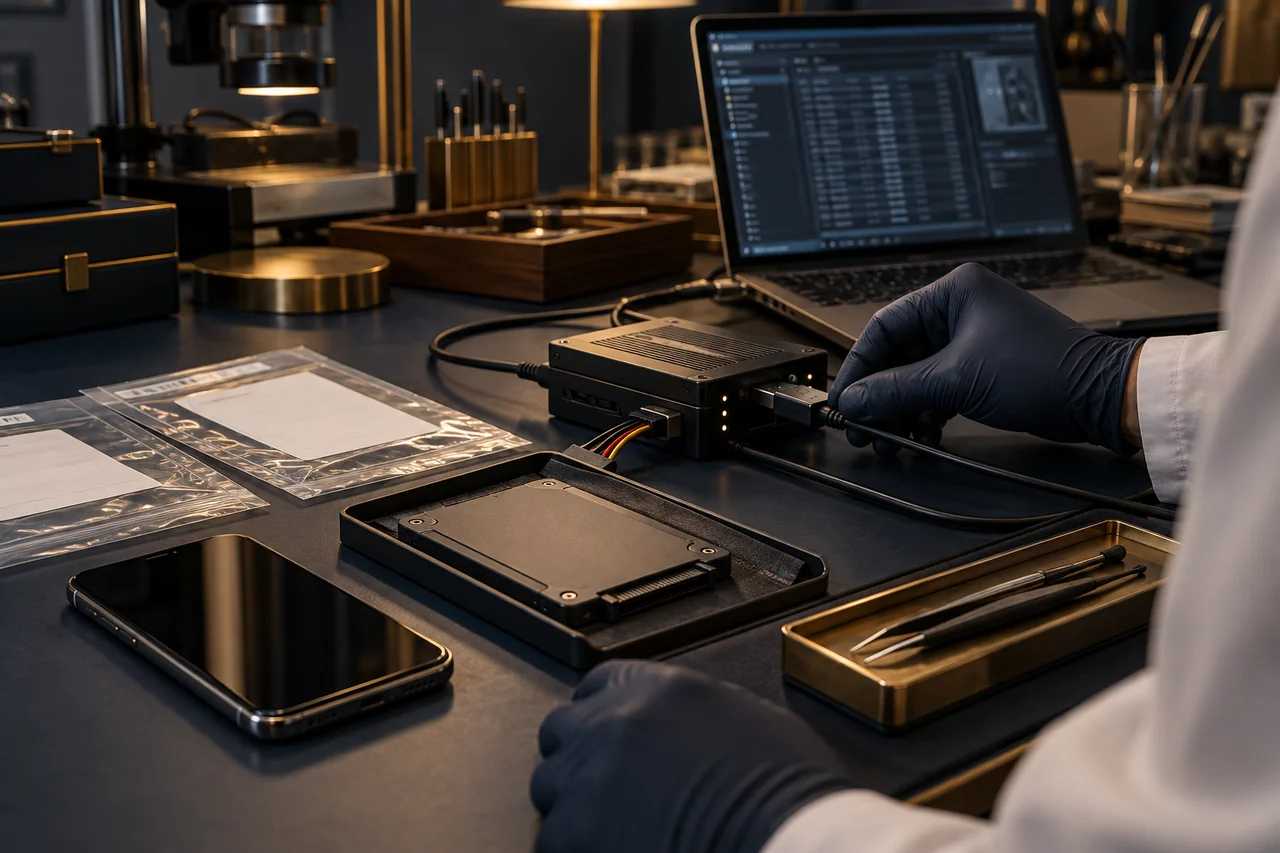
Digital & Mobile Forensics
Legal & Digital Evidence
AI RISK & Critical Infrastructure
Specialist expertise for scenarios in which AI systems, automation, and autonomous agents affect critical processes, human oversight, and the ability to make reliable decisions under pressure.
GEOPOLITICAL ANALYSIS
Geopolitical analysts and advisors for scenarios in which conflicts, state actors, regional instability, supply chains, and strategic dependencies change an organization’s cyber exposure.
Digital & Mobile Forensics
Digital forensics specialists and partner laboratories for acquisition, tool-based analysis, and technical work requiring dedicated infrastructure, tools, or specialist expertise.
Legal & Digital Evidence
Legal professionals for engagements in which technology, legal significance, governance, and evidentiary strategy call for an interdisciplinary perspective.
Regardless of the professionals involved, the method remains the same: define the question, evaluate sources, separate facts from inferences, compare alternative scenarios, and state what cannot yet be established.
Because, in complex situations, the goal is not to eliminate uncertainty artificially. It is to make uncertainty understandable before it becomes an unrecognized part of the decision.
Privacy and browsing preferences
These pages do not use analytics or profiling tools. “Accept all” only allows accessibility settings to be remembered in this browser. You can also use them without saving them.
Your choice is remembered for 6 months. Closing this notice is equivalent to rejecting optional preferences. Cookie Policy · Privacy